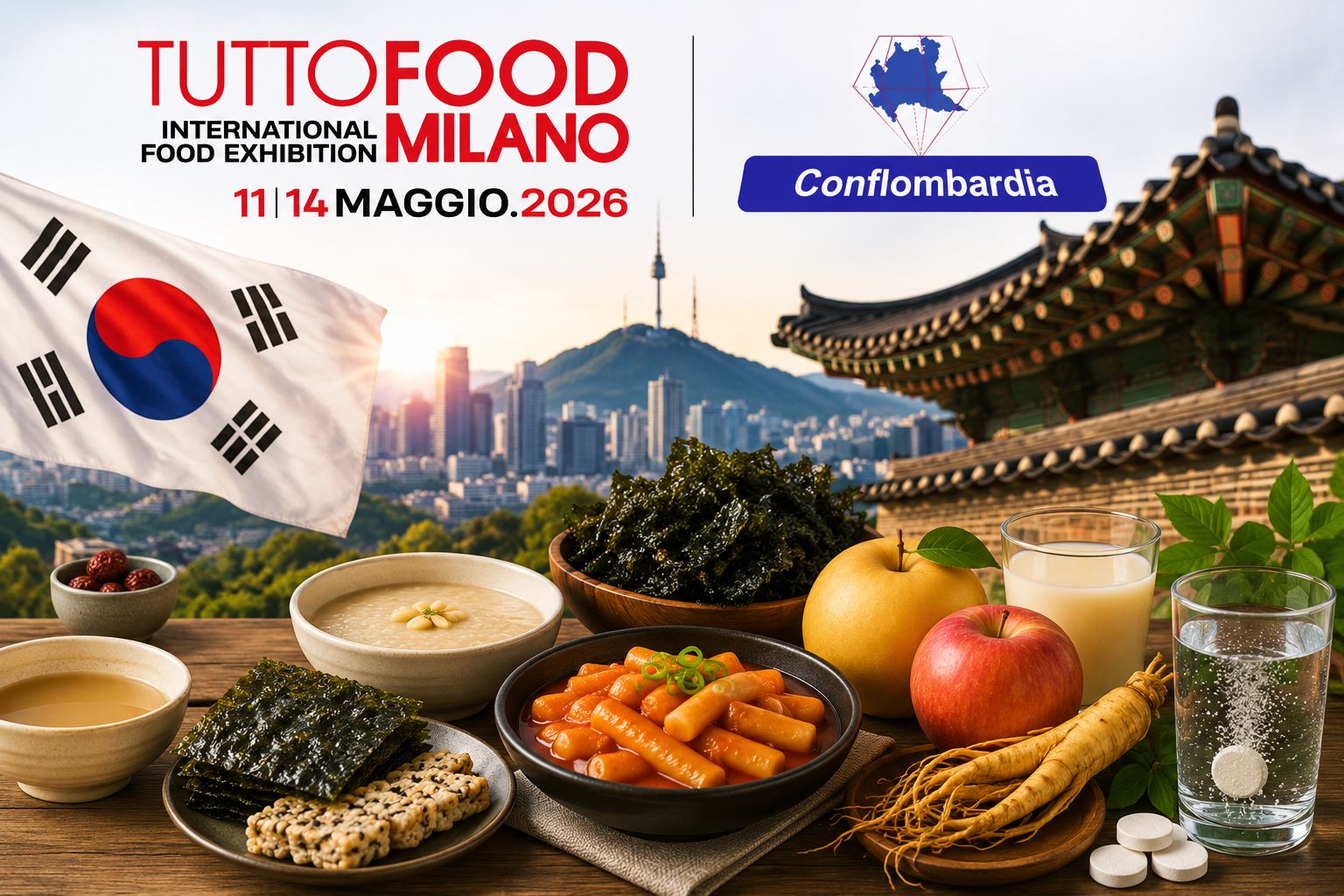
The TUTTOFOOD 2026 represented an extraordinary opportunity for Conflombardia to explore new horizons in the global food industry and to better understand the trends that will shape the international agri-food market in the years ahead. Among the most remarkable areas of the exhibition was the South Korean pavilion, where we encountered companies capable of combining tradition, innovation, sustainability, and strong cultural identity. During our visit, we met businesses that are transforming centuries-old traditions into modern products designed for international markets without losing authenticity or connection to their territory. At a time when consumers are increasingly looking for healthy, traceable, sustainable products with a genuine story behind them, many Korean companies are successfully positioning themselves on the global stage. These are no longer niche ethnic products, but fully structured food lines ready for retail chains, specialty stores, horeca channels, and modern experiential food concepts. The Korean presence at TUTTOFOOD showcased a modern, highly organized country prepared to engage with European markets through high-quality standards, refined packaging, international certifications, and powerful product storytelling. It is precisely this balance between tradition and global vision that impressed the Conflombardia delegation attending the fair.
Dysskorea – The Taste of the Sea Turned into Contemporary Excellence
Among the companies that impressed us most was Dysskorea, founded in Boryeong-si, a coastal city renowned for the superior quality of its seaweed. Visiting their stand made it immediately clear how much philosophy and precision can lie behind an apparently simple product. Dysskorea specializes in laver seaweed products, transforming a traditional Korean ingredient into modern snacks aimed at an international audience increasingly focused on healthy and natural foods. Their range includes thin seaweed sheets traditionally served with rice, as well as crispy snack varieties designed for convenient consumption while maintaining a strong gastronomic identity. What stood out during our meeting was the company’s dedication to preserving the authentic flavor of the sea without excessive industrial processing that often weakens product quality. Their attention to international certifications such as HACCP and FSSC 22000 further demonstrates a serious commitment to European importers and distributors. As Western consumers continue to seek healthier snack alternatives rich in minerals and lower in processed ingredients, Dysskorea represents a company with significant growth potential in European markets. This is not merely an exotic product, but a modern food solution responding to current consumer demands for lightness, convenience, wellness, and authenticity.
YS Apple – Fruit Purity and Territorial Identity
Another company that drew significant attention from our delegation was YS Apple, producer of the renowned Yesan Hwangto Apples. Behind this brand lies a fascinating production philosophy built around the connection between territory, cultivation, and final product quality. The apples grow in the yellow clay soil of Yesan County, a geological characteristic that contributes unique organoleptic qualities to the fruit. During our discussions with the company, a strong artisanal production culture emerged despite the company’s clear international export structure. Every apple is hand-selected and treated as a premium product capable of becoming not only food but also a symbol of prestige and gifting culture. This attention to perceived quality extends to their processed products as well, including natural juices, apple chips, and snacks that preserve the authentic flavor of the fruit. European consumers are increasingly rewarding products that tell a genuine and verifiable story, and YS Apple appears to fully understand this market evolution. This is not simply an industrial agricultural business but a company capable of transforming territory into commercial value. It is an approach that many Italian producers can recognize and appreciate, potentially creating opportunities for future collaboration between Korean and Italian food operators.
Kukdduk / Cook-Tok – Korean Street Food Conquering Global Markets
One of the most dynamic and highly visited stands belonged to Kukdduk, known internationally through the Cook-Tok brand. The company has achieved something remarkably difficult: transforming one of Korea’s most iconic street foods into a product easily exportable and reproducible worldwide without losing authenticity. Tteokbokki, the traditional dish made of soft rice cakes served with spicy sauces, has become one of the most requested Korean foods among international consumers. Kukdduk anticipated this market evolution early and invested years into developing home meal kits that remain faithful to the original recipe while being simple to prepare. The result is a product capable of introducing European consumers to Korean culinary culture without creating accessibility barriers. The various flavors—from classic sweet and spicy versions to Crazy Hot, Black Pepper, and jjajang—demonstrate the company’s strategic ability to adapt products to different tastes while maintaining a strong Korean identity. With exports to more than thirty countries and over twenty million packages sold, Kukdduk clearly demonstrates how South Korea is becoming a global power not only in technology and culture but also in internationally scalable food concepts. For Italian importers, distributors, and horeca operators, companies like Cook-Tok represent a concrete opportunity to intercept growing demand for contemporary Asian cuisine, especially among younger generations and metropolitan consumers.
Aram Food – Korean Tradition Reimagined for Global Markets
Among the companies we encountered at TUTTOFOOD 2026, Aram Food stood out for its ability to combine Korean food tradition, industrial innovation, and international vision. Founded in 1999, the company built its identity around deeply traditional Korean beverages such as sikhye and sujeonggwa, drinks that represent far more than simple refreshments in Korean culture—they are symbols of family, conviviality, and historical heritage. Visiting their exhibition space revealed a strong focus on perceived product quality and a clear production philosophy: creating foods and beverages that the company itself would proudly serve to its own family members. This apparently simple approach is today one of the most powerful elements in global food marketing because it communicates authenticity and trust. At the same time, Aram Food has evolved by developing modern snacks, ready meals, and innovative product lines through brands such as Samsiokki and Red Raccoon, demonstrating a remarkable ability to understand global consumption trends. Certifications including HALAL, FSSC 22000, and FDA further confirm a production structure already prepared for complex international markets. In a European context where consumers increasingly seek premium ethnic products that are also safe and certified, Aram Food appears particularly attractive for distributors looking to diversify their portfolio with authentic yet internationally compliant products.
Naturelica – The New Face of Soju Between Innovation and Cultural Identity
One of the most innovative and intriguing companies we encountered was Naturelica, a young business based in Chungju that is redefining traditional soju through a modern, internationally oriented vision. Soju has historically been one of South Korea’s symbolic distilled beverages, deeply rooted in the country’s social culture. Naturelica, however, has chosen to take the concept further by transforming it into a new sensory experience more aligned with the tastes of younger generations and global consumers. Their Arirang Soju line offers an impressive variety of flavors made from fermented apples, pears, and numerous natural ingredients, creating a product that remains connected to tradition while presenting a completely contemporary image. The company’s choice to use fructose instead of artificial sweeteners also reflects a strong understanding of modern consumer expectations regarding ingredient quality and product composition. During our meeting, it became evident that Naturelica has developed a highly structured international strategy aimed at turning soju from a primarily Asian beverage into a global product suitable for cocktail bars, premium venues, and European horeca channels. As the Italian spirits market continues evolving toward innovative drinking experiences, products like those from Naturelica could become highly attractive for specialized distributors eager to anticipate future beverage trends.
Humanwell – Functional Wellness Through Food Innovation
Humanwell perfectly represents the new generation of Korean companies capable of combining nutrition, wellness, and functional food innovation. Founded in 2000, the company has developed a range of snacks based on the beneficial properties of seaweed and ginseng, two ingredients deeply embedded in Asian food culture and increasingly appreciated in Western markets. What makes their products particularly interesting is the ability to transform functional foods into enjoyable and accessible snacks even for consumers unfamiliar with Asian flavors. Variants flavored with red ginseng, green tea, kimchi, and wasabi demonstrate a strong commitment to innovation while maintaining balance between taste, health, and cultural identity. Alongside roasted seaweed products, Humanwell also offers brown rice snacks and organic product lines, intercepting some of the strongest trends in the contemporary food market: healthy eating, functional snacks, organic foods, and natural ingredients. International certifications such as FSSC 22000, FDA, and ISO 22000 play a strategic role in enabling access to European and North American markets. Existing exports to multiple countries further confirm that these products are no longer confined to ethnic niches but are becoming part of a new global wellness-oriented food category. For the Italian market, Humanwell could represent an interesting opportunity for both specialty retail and horeca operators seeking innovative, high-value snack solutions.
FnBio – Technology, Wellness, and Practical Innovation
Among the companies best representing Korea’s ability to innovate within the wellness and nutraceutical sector is FnBio Co., Ltd., a company specializing in effervescent tablets and functional supplements. During our visit, we explored a production model combining research, convenience, and international market orientation. FnBio does not simply manufacture supplements; it develops solutions designed for modern consumers seeking practical, fast, and lifestyle-compatible wellness products. The company has invested heavily in proprietary effervescent technology, transforming vitamins, natural extracts, and traditional Korean ingredients into portable and user-friendly formats. Their product lines include dietary supplements, high-dose multivitamins, and red ginseng-based effervescent tablets, an ingredient historically associated in Korea with health and longevity. FnBio’s strength lies in its ability to modernize the supplement experience while maintaining a strong connection to traditional Asian herbal culture. The company’s established export activity across several Asian markets confirms the effectiveness of its business model and the international readiness of its products. As the European wellness and supplement market continues to grow rapidly, especially among consumers focused on prevention and quality of life, companies like FnBio could represent highly attractive commercial opportunities for importers and specialized distributors.
South Korea – A Food Industry Model Looking Toward the Future
What clearly emerged from our experience at TUTTOFOOD 2026 is that South Korea is not simply exporting food products, but an entire industrial and cultural vision of contemporary food production. The companies we encountered share several highly significant characteristics: strong territorial identity, innovation capacity, attention to quality, international standards, and sophisticated brand storytelling. Every product tells a precise story and conveys an image of a modern Korea that is dynamic, technologically advanced, organized, and capable of transforming tradition into global economic opportunity. This approach should encourage reflection among many European businesses as well. International markets today reward not only the product itself, but also the experience, storytelling, credibility, and trust surrounding a brand. Korean companies present at the fair clearly demonstrated their understanding of this evolution. Many are rapidly expanding internationally, successfully entering traditional retail channels as well as premium, wellness, and gourmet segments. For Conflombardia, this experience also represented an important strategic observation opportunity: understanding how new global players are reshaping the agri-food industry helps Italian companies, distributors, and operators prepare for future market transformations.
Invitation to Our Partners – Building New International Commercial Opportunities
The companies encountered during TUTTOFOOD clearly demonstrate that collaboration between Italy and South Korea in the agri-food sector can open highly interesting opportunities. Many of these businesses are actively seeking reliable partners to expand distribution networks, strengthen their European presence, and build long-term commercial relationships. For this reason, we extend a direct invitation to wholesalers, distributors, horeca operators, and food entrepreneurs within the Conflombardia PMI network: paying close attention to these companies means anticipating future market trends and positioning ahead of competitors in sectors destined for strong growth. European consumers are rapidly changing their habits, preferences, and expectations, and products like those presented by these Korean companies may represent important new commercial development opportunities. Conflombardia will continue monitoring these international opportunities with the goal of creating concrete connections between producers, importers, and Italian operators, fostering strong and mutually beneficial commercial relationships across the entrepreneurial system. Today more than ever, the future of food depends on the ability to build bridges between cultures, innovation, and global markets.