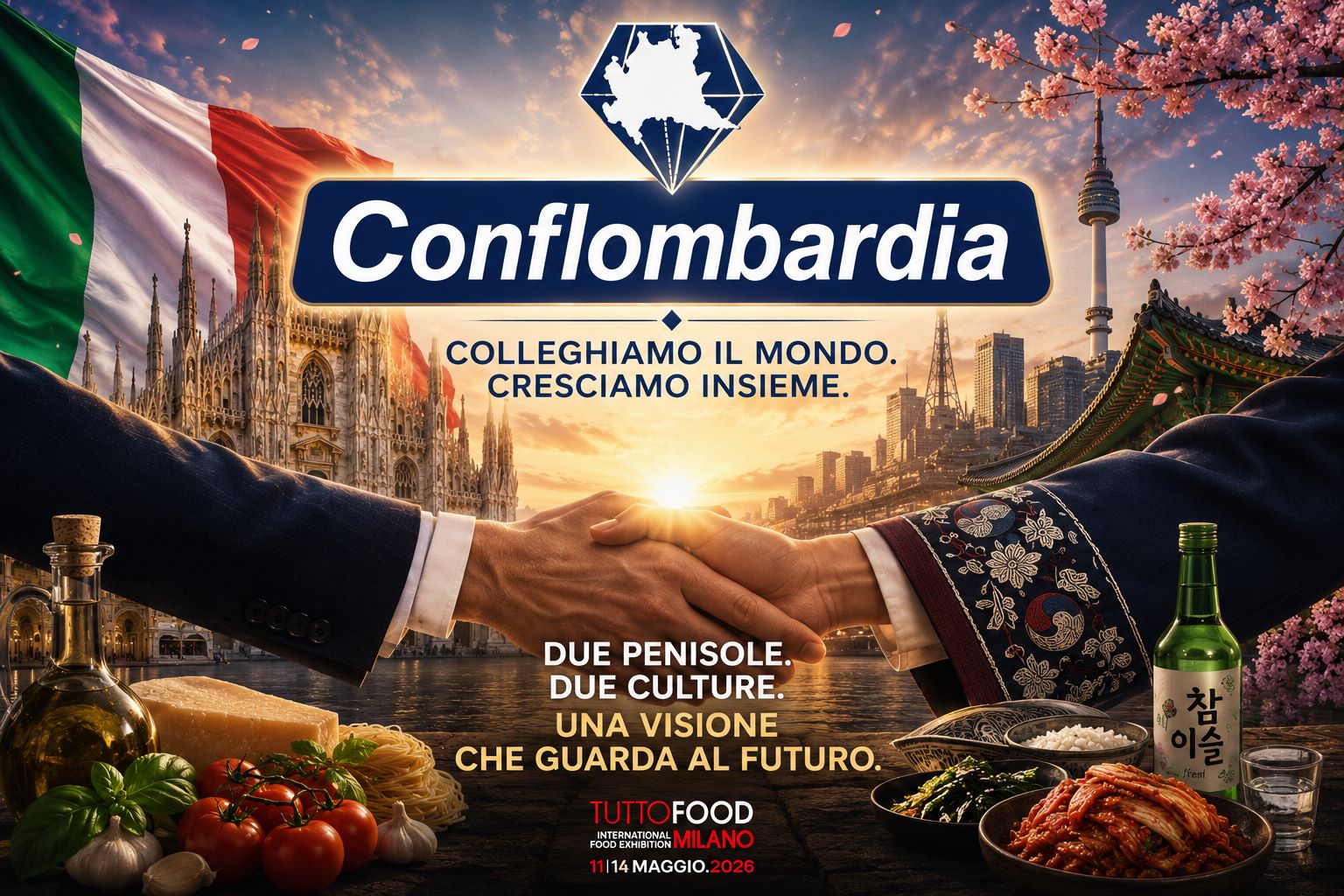
An Encounter That Became a Strategic Reflection
There are encounters that seem to begin almost by chance while walking through the corridors of a major international trade fair, yet they end up becoming something much deeper. Today, during our presence at TUTTOFOOD 2026, as Conflombardia PMI we visited with particular interest the exhibition areas dedicated to South Korea and Taiwan, within the international sections where companies and institutions from the Philippines were also present.
Walking among the stands, observing products, commercial approaches, exhibition styles, organizational capabilities, and entrepreneurial mindsets, one reflection emerged almost naturally: in many ways, South Korea deeply resembles Italy. This is not merely a superficial impression or a simple cultural sympathy. There are in fact numerous structural, territorial, economic, and even character-related similarities between the Italian and Korean people. Both countries are peninsulas. Both had to build their strength more through ingenuity, work ethic, and productive capacity than through vast natural resources. Both possess a strong cultural identity, a cuisine recognized worldwide, a deep sense of family, and an extraordinary ability to transform tradition and identity into economic and commercial value.
The Korean SME Mindset and Its Similarities with Italy
Observing the Korean operators present at the fair, one can clearly perceive a mentality that, in many aspects, recalls that of the best Italian SMEs: attention to detail, national pride, enhancement of the product, strong cultural identity, and the desire to export not only goods, but also image, lifestyle, and vision. South Korea, exactly like Italy, has understood that today value does not lie solely in the final product, but in the ability to tell its story, make it recognizable, and build a strong international reputation around it.
This is why witnessing the Korean presence at TUTTOFOOD does not simply mean observing a commercial exhibition, but understanding how certain nations are strategically working on their global cultural and economic expansion. Much like the best expressions of Made in Italy, Korea is investing not only in products, but in perception, trust, aesthetics, and national identity. This approach represents one of the strongest common points between the two countries and offers an important lesson for modern SMEs operating in increasingly competitive global markets.
Taiwan, Innovation, and the Future of International Relations
Taiwan also demonstrated an extremely interesting presence. A dynamic, modern, and highly technological reality, yet at the same time strongly focused on quality, commercial relationships, and the construction of international partnerships. In a world that is changing rapidly, one fundamental element is becoming increasingly clear: international relations can no longer be viewed solely as relationships between governments or multinational corporations.
Today, real connections are also born between territories, associations, entrepreneurial networks, professionals, communities, and businesses that share common visions. Taiwan represents a concrete example of how innovation, organization, and strategic thinking can transform a territory into a globally influential economic player. For Italian SMEs, this represents a powerful reminder that international competitiveness is no longer based solely on size, but on the ability to create reliable relationships, move quickly, and build strong operational networks.
Conflombardia PMI and the International Ambassador Project
It is precisely in this direction that the international project of Conflombardia PMI is evolving. For some time now, we have been working to expand our network of Conflombardia Ambassadors around the world, creating territorial reference points capable of building relationships, operational connections, and concrete opportunities between Italy and different international realities.
This is not simply a symbolic initiative, but the construction of an operational network capable of facilitating business relationships, cultural exchanges, partnerships, and territorial development. Today many Italian SMEs possess extraordinary quality, know-how, and productive capabilities, yet often struggle to access credible international networks. At the same time, many foreign companies are looking for reliable partners in Italy who understand both local entrepreneurial culture and international business dynamics. The Conflombardia Ambassador project was created precisely to bridge this strategic gap.
Italy as an International Nation
Today there is another major strategic reality that can no longer be ignored: Italy itself has become an international nation. In our country, people from every part of the world live, work, invest, and build businesses. Korean, Filipino, Chinese, South American, African, European, and Middle Eastern entrepreneurs contribute every day to the Italian economy, bringing skills, culture, relationships, and access to new markets.
For too long, internationalization has been viewed only as something directed outward, while many of the most important international connections are already present within Italy itself. Foreign entrepreneurial communities are not simply territorial presences; they can become real strategic bridges between Italy and global markets. Understanding this transformation means changing perspective and recognizing the enormous economic and cultural value already existing inside the Italian productive system.
Ambassadors of the Nations of the World in Italy
This is why Conflombardia is developing the idea of creating a network of “Ambassadors of the Nations of the World in Italy”: individuals capable of becoming real bridges between cultures, businesses, and territories. Not merely symbolic representatives, but operational figures able to foster concrete economic, cultural, and entrepreneurial relationships.
These are people capable of understanding both the Italian mentality and the mentality of the international communities currently living in our country. In an era marked by geopolitical tensions, economic crises, and rapid global transformations, creating authentic connections between peoples and businesses may become one of the most important tools for generating stability, development, and new opportunities.
The Future Belongs to Those Who Build Connections
Therefore, today’s presence within the areas dedicated to South Korea, Taiwan, and the Philippines was not simply a trade fair visit. It was also the confirmation of a vision. The future increasingly belongs to those who know how to build credible international networks, solid territorial relationships, and systems capable of connecting different worlds while maintaining a strong identity.
And perhaps this is where one of the deepest similarities between Italy and South Korea truly lies: both have understood that real value emerges when tradition, identity, innovation, and human relationships are able to move forward together. In a world becoming increasingly global, true strength will not come from losing one’s identity, but from transforming it into a bridge capable of connecting cultures, economies, and people.