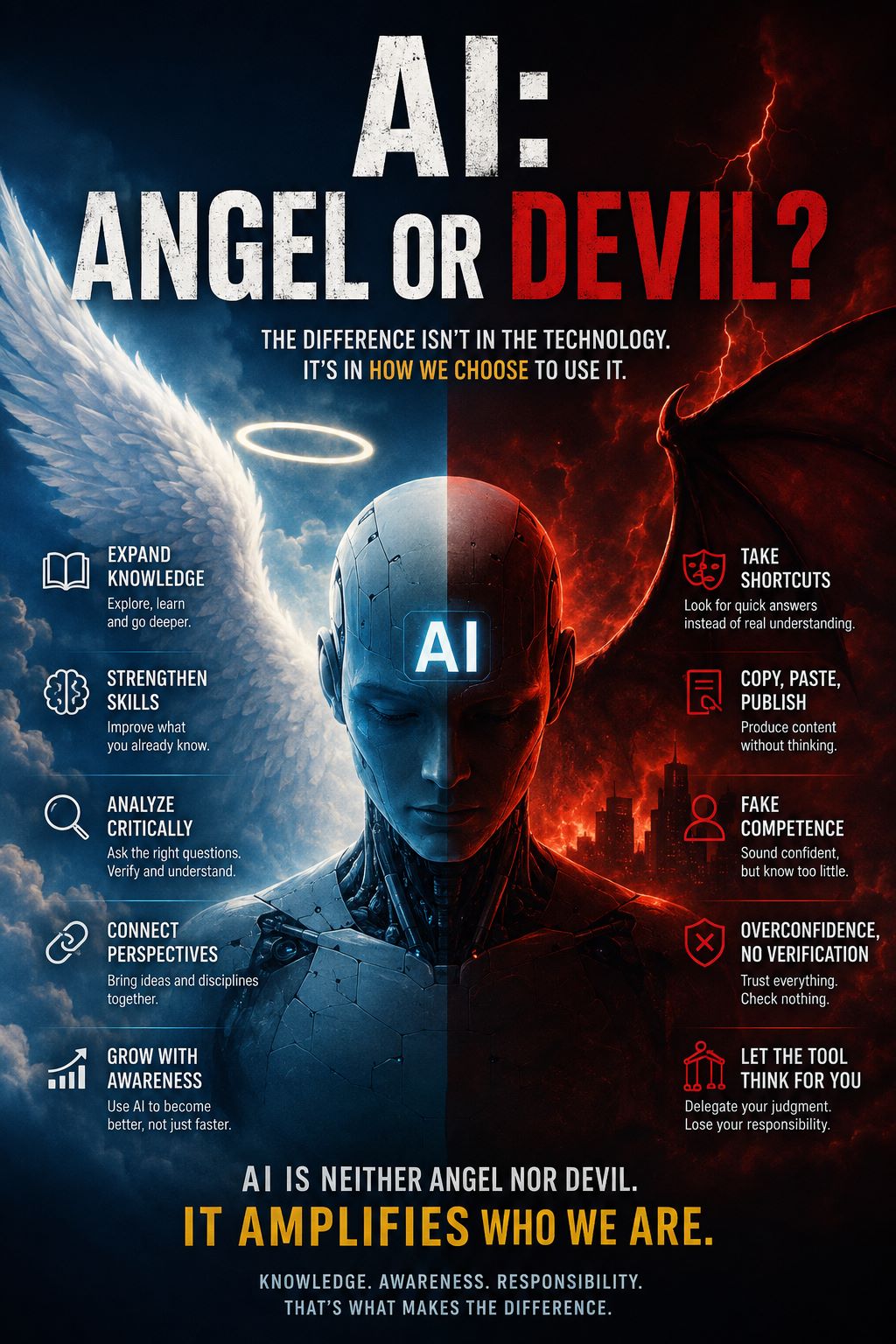
Artificial intelligence can expand knowledge and strengthen competence, but it can also create the illusion of possessing skills we have never truly developed. The difference often lies not in the tool itself, but in the person using it.
USING ARTIFICIAL INTELLIGENCE EVERY DAY HAS TAUGHT ME THAT THE REAL VALUE IS NOT IN THE FIRST ANSWER
I use artificial intelligence practically every day, and by now it has become part of many of the activities I carry out, from communication to document analysis, from project development to research, and even to the development of ideas that often begin as rough intuitions and need to be organised, tested and explored before they become something I consider genuinely usable.
At the beginning, as I believe happens to many people, what strikes you most is the speed with which AI can return an articulated, orderly response that already appears ready to use. Once you move from curiosity to daily use, however, speed quickly stops being the most important aspect, because you realise that receiving an answer in a few seconds does not necessarily mean receiving the best answer and, above all, it does not mean that the answer really reflects the thought you were trying to develop.
In the way I work, it often happens that I start from an idea, ask artificial intelligence to develop it and then find myself intervening in the direction it has taken, perhaps because a decisive element is missing, because the reasoning has moved too far away from the real context or simply because, even though the result is formally correct, it does not fully represent what I actually think.
For me, that is when the most interesting part of the work begins, because the conversation is no longer a matter of asking a question and receiving an answer. It becomes a process in which I bring experience, information, doubts and corrections into the discussion and, at times, even find myself reconsidering the position from which I originally started.
That is why I find it difficult when the debate around artificial intelligence is reduced to whether it is right or wrong to use it for writing, almost as if the only question were who physically typed the words on the keyboard. What interests me far more is how much work, knowledge and judgement went into the process that produced those words.
Artificial intelligence can certainly accelerate an important part of our work and provide tools that would have been difficult to imagine only a few years ago, but precisely because of this capability the role of the person using it becomes even more important, because someone must ultimately be able to decide whether what has been produced is correct, coherent with the context and solid enough to be used and, above all, signed with their own name.
COMPETENCE ALSO MEANS KNOWING WHEN AN ANSWER DOES NOT SURVIVE CONTACT WITH REALITY
This becomes even more evident when I use artificial intelligence within areas in which I have built real experience and knowledge over time.
I work professionally in the field of security and, over the years, I have had to deal with service organisation, procedures, responsibilities, training, technology and operational management, in other words with all those issues that may appear relatively simple on paper but change completely when they have to be applied inside a real organisation, where people, roles, skills, time, responsibilities and the consequences of decisions all come into play.
When I bring these subjects into a conversation with artificial intelligence, I therefore do not start from its answer in order to form my opinion, because I already have a body of experience that allows me to compare what is being proposed with what I know, with what I have seen work, with what I have seen fail and with those practical dynamics that are often missing from the first theoretical reading of a problem.
More than once I have found myself looking at solutions that were extremely well constructed from a formal point of view but which, knowing the sector, immediately revealed weaknesses in their practical application, because a procedure may be flawless on paper while failing to take sufficient account of the people who must apply it, just as a technological solution may appear perfect until it is placed inside an organisation where responsibilities, training, control and operating methods must all be clearly defined.
In these situations, competence does not mean having every answer, and it would be presumptuous to believe otherwise. It means having enough knowledge to recognise when something does not add up, to understand which element needs to be explored further and to know where to look before turning a well-written answer into a decision.
Over the years I have also developed knowledge across different areas, and this helps me greatly when working with artificial intelligence, because value does not always come only from vertical expertise in a single subject. Often it comes from the ability to connect organisational, regulatory, technological, communication and management issues which, if considered separately, would provide only a partial picture of the problem.
I therefore do not use artificial intelligence to enter fields about which I know nothing or to manufacture a competence that I do not possess. I use it to deepen what I already know, fill specific gaps, retrieve information more efficiently, connect different areas of knowledge and, when necessary, arrive better prepared for discussion with people whose specialist expertise is deeper than mine.
For me, the distinction lies precisely here: using artificial intelligence to expand and strengthen a body of knowledge already built over time is very different from allowing the tool to create the appearance of a competence that, in reality, has never been developed.
DEEPENING A COMPETENCE IS VERY DIFFERENT FROM CREATING THE APPEARANCE OF ONE
One of the aspects I find most interesting about artificial intelligence is the possibility of rapidly exploring specific elements within a field we already understand, particularly when we encounter a technical, regulatory, organisational or specialist issue that requires a deeper level of understanding before we take a position or engage with someone whose expertise is more specialised than our own.
In the past, this type of investigation often required considerably more time, because it meant identifying the right sources, locating documentation, selecting what was genuinely relevant and then trying to connect information coming from different contexts. Today artificial intelligence can make this process much more accessible, provided it is used as a tool for deeper understanding rather than as a substitute for the process required to truly understand what we are reading.
This distinction matters to me because obtaining information, understanding a concept more clearly and developing real competence are not the same thing, and above all they do not happen at the same moment.
I can use AI to clarify a term that I only partially understand, reconstruct the regulatory framework surrounding an issue, compare different interpretations, identify documents worth reading or gain a more precise explanation of something I had never previously needed to examine in detail. All of this genuinely increases my knowledge, but it only becomes valuable when that information is understood, compared with what I already know and placed within a coherent framework.
That is precisely the step that risks disappearing when artificial intelligence is used as a shortcut.
The ease with which we can now obtain an articulate explanation may create the impression that the distance between knowing very little and knowing a great deal has suddenly become minimal, but in reality there remains an important difference between being able to talk about a subject and having developed enough knowledge and experience to accept professional responsibility for a judgement within that subject.
I therefore consider AI a very useful tool for filling specific gaps, because nobody possesses complete knowledge of every aspect of the areas in which they work and, in fact, I believe that awareness of what we do not know is itself part of being competent. The real issue is understanding how far we can reasonably go on our own and when it becomes necessary to stop, investigate further or involve someone with deeper specialist knowledge.
In this sense, artificial intelligence can also improve our relationship with professionals, because arriving at a discussion having already understood the context, identified the critical points and formulated more precise questions allows us to make better use of the expertise of the person in front of us. It does not mean replacing that professional; it means being able to engage in the conversation with greater awareness and to understand their guidance more effectively.
This is perhaps where one of the more mature uses of AI can be seen: not in making us appear competent in everything, but in helping us understand more clearly where our knowledge ends, which areas we can deepen and which instead require experience, specialisation and responsibility that no automated answer can build on our behalf.
CONNECTING DIFFERENT COMPETENCES CAN CHANGE THE WAY WE UNDERSTAND A PROBLEM
One of the aspects I find most useful when working with artificial intelligence emerges when a problem does not truly belong to a single discipline but sits at the intersection of different areas of expertise and therefore needs to be examined from several perspectives before it can be fully understood.
I encounter this situation frequently because, in reality, many problems are never only technical, only organisational, only regulatory or only related to communication. A decision concerning security, for example, can simultaneously have operational consequences, legal responsibilities, training requirements, economic costs, effects on the organisation of work and implications for internal communication. Looking at only one of these dimensions risks producing a solution that is correct within a single area but weak when it has to interact with everything else.
Having gained experience in different fields over time naturally leads me to reason in this way, trying to understand not only whether a solution works in theory, but also what effects it may have on people, on the organisation, on responsibilities and on the objectives that are being pursued.
Artificial intelligence can become particularly interesting in this kind of work because it makes it possible to compare information, perspectives and disciplines that would normally be considered separately, helping me identify whether I may be overlooking an important element or whether a decision that appears correct from one point of view could create problems when examined from another.
This does not mean that AI should decide which connections truly matter, because even here someone needs to understand the context and know how to frame the problem in all its complexity. If I do not know that a particular choice may have organisational consequences, I am unlikely to investigate them; if I am unaware of a responsibility or a constraint, I may receive an enormous amount of information without noticing that the most important element is precisely the one that is missing.
This is where transversal competence becomes even more valuable, because it allows information not to be treated as a series of isolated elements but as part of a wider picture, where one area of knowledge can help us interpret another and where a question arising in one field may reveal a problem apparently belonging to a different one.
In my way of working, this means using artificial intelligence not so much to obtain a ready-made solution, but to widen the field of analysis, put a hypothesis under pressure and understand whether I am looking at the problem from enough perspectives before reaching a conclusion.
I believe this is also why AI can become an especially effective tool for people who have accumulated different experiences over time and learned not to reason in separate compartments. It does not automatically improve a decision, but it can help bring relationships, consequences and contradictions to the surface that deserve to be considered before that decision is made.
This way of working becomes even more important when we move from analysis to communication, because bringing together correct information is not enough if the final result loses the voice, experience and thought of the person it is supposed to represent.
WHEN ARTIFICIAL INTELLIGENCE ENTERS COMMUNICATION, THE RISK IS LOSING THE VOICE OF THE PERSON WHO WRITES
Communication is probably where the use of artificial intelligence becomes both most visible and most delicate, because today it is possible to start from a few instructions and obtain within seconds a text that is orderly, grammatically correct, well structured and apparently ready to publish.
The problem is that a text can be extremely well written and still not genuinely belong to the person whose name appears beneath it.
I see this in my own daily work with AI, because sometimes a first version may be technically correct, perhaps even elegant, but have a rhythm, language or line of reasoning that does not represent me. In those cases I do not consider the work complete simply because the text reads well; I return to the content, change the structure, remove passages that feel artificial, add what comes from my own experience and, above all, try to bring back into those words the way I would actually develop that thought.
This article itself, in some ways, comes from exactly that process.
During its development I read versions that contained correct ideas but that I did not recognise as mine, because they were too orderly, too schematic, built around sequences of short sentences and conclusions designed for effect which may work formally but do not correspond to the way I write and, before that, to the way I think.
It was necessary to intervene several times, change the direction and reconstruct entire passages, not because artificial intelligence was incapable of producing a good text, but because a good text is not automatically my text.
This, in my view, is one of the aspects we should examine more carefully when we use these tools in professional, political, associative or personal communication, because if we simply enter a request, receive an answer and publish it exactly as it is, we risk gradually handing over not only the writing but also part of our communicative identity to a system that inevitably builds language from patterns much broader than our individual experience.
This does not mean that artificial intelligence should not be used for writing, because that is not a conclusion I share and it would contradict the way I use it myself. It does mean that we must remain present inside the text, retaining the ability to recognise when a sentence does not belong to us, when a passage simplifies too much of what we are trying to say or when the form becomes so perfect that it removes precisely those characteristics that make a person recognisable.
Even our errors, our hesitations, the way we build an argument, the experiences we decide to include and even certain imperfections are part of communication, because behind a text there should not merely be someone whose name appears at the bottom, but a person who genuinely recognises themselves in the ideas, words and conclusions they are placing before others.
For this reason, I believe that in the future it will become less and less interesting to establish whether a text was written with or without artificial intelligence, while it will become far more important to understand whether the person who published it actually built it, understood it and made it their own.
And this inevitably brings us to the final stage of the argument, because when a text, an analysis or a decision is published under our name, the issue is no longer simply how it was produced, but the responsibility we are willing to assume for what we have chosen to use.
IN THE END, RESPONSIBILITY REMAINS WITH THE PERSON WHO CHOOSES TO SIGN, PUBLISH OR USE THE RESULT
The more I use artificial intelligence, the more I believe that, beyond every discussion about the quality of texts, the speed of responses or the ability to process enormous quantities of information, there is one point we cannot afford to lose: final responsibility always remains with the person who decides to use what has been produced.
If I publish a text under my name, use an analysis to guide a decision, bring a document into an organisation or transform an AI-generated answer into a decision that will affect other people, I cannot pretend that the use of a technological tool somehow reduces my responsibility for the outcome.
This is even more important in contexts where communication, evaluation or decision-making can have real consequences for a company, a worker, an organisation or a community, because in those situations it is not enough for the content to be well written or technically convincing. It must be understood, checked to the extent required, placed in the correct context and, above all, accepted with full awareness of the consequences it may produce.
This is also why I find it difficult to think of artificial intelligence simply as a substitute for activities we previously carried out directly. In many situations it can certainly reduce workload, accelerate research or help structure an argument, but precisely because it greatly increases our capacity to generate content and analysis, I believe it should also make us more rigorous when deciding what to keep, what to discard and what to use.
The ease with which we can now produce something that appears professional can create a dangerous illusion: that the quality of the form is enough to certify the quality of the content. Anyone who actually works with documents, decisions, people and responsibility knows that this is not how reality works, because a sentence may be perfect and still contain the wrong assumption, just as an analysis may be extremely convincing while overlooking the one element that will ultimately make the difference in practice.
I therefore believe that the real cultural shift in the use of artificial intelligence will not simply consist in learning how to obtain better answers, but in learning how to retain control over the path that leads from those answers to our decisions. That means knowing when to investigate further, when to verify information outside the tool, when to seek specialist expertise and also when to stop because we still do not have enough elements to consider the work complete.
The same applies to communication. If a text carries my name, I am not particularly interested in determining what percentage was physically generated by artificial intelligence and what percentage I wrote directly myself; I am far more interested in knowing whether that text truly represents my thinking, whether I can defend its claims, whether I understand its limitations and whether I am prepared to take responsibility for the words I have chosen to make public.
Perhaps this is where the discussion should increasingly focus in the coming years, because the use of artificial intelligence will become more and more normal and it will probably become both harder and less useful to distinguish between what was produced directly by a person and what was developed with the support of a machine.
What will continue to make the difference is the quality of the person using that tool, the knowledge they bring into the process, their ability to recognise their own limits, their willingness to verify what they do not understand well enough and, above all, their determination not to delegate to technology that part of responsibility which inevitably belongs to the person who, at the end of the process, decides to put their name beneath what has been produced.